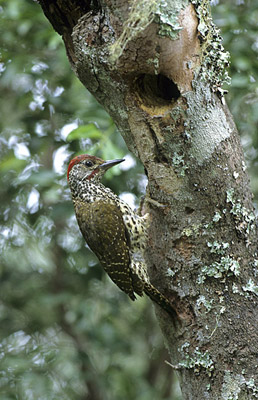
Knysna Woodpecker Campethera notata is endemic to South Africa. The sexes differ slightly with males (as in this photo) having an all-red-crown and nape and a red malar stripe, whilst female has red only on the hind-crown and an indistinct black malar. It is classed as 'near threatened' due to having a restricted range. The species is found in coastal, lowland, evergreen woodlands, scrub, bush and thickets, especially with euphorbia and milkwood, mainly along the Eastern Cape but also northwards into southern KwaZulu-Natal. Photo by Warwick Tarboton.
Sunday, 9 October 2011
Saturday, 1 October 2011
Habitats: Bamboo - Bambuseae
There are around 1450 species of bamboo (an evergreen member of the grass family) around the world. Many occur in tropical regions, mainly in SE Asia but also the Americas and Africa, and some in temperate regions. As a habitat for picids, bamboo may not immediately spring to mind, however many piculets and some true woodpeckers forage and nest in bamboo. Others, such as the appropriately named Bamboo Woodpecker Gecinulus viridis of south-east Asia, specialise in this habitat. For many species bamboo is also a favoured substrate upon which to drum as it resonates very well, especially when mature or dead. Photo taken in northern Malaysia, Gerard Gorman.
Sunday, 25 September 2011
Picid in Focus: Lewis's Woodpecker
At about 27cm in length, Lewis's Woodpecker Melanerpes lewis is the largest member of the genus. It is a heavy-looking, dark but handsome, long-tailed, long-winged picid. Most of head, upper-parts and wings are dark green, it has a red face, a grey nape, collar and chest, and a pinkish breast and belly. In flight it looks
particularly dark. The sexes are almost identical, not exhibiting sexual
dimorphism in colour. Juveniles lacks the red face and grey collar and are less pink below. Photo by Steve Shunk, Oregon, USA.
Sunday, 18 September 2011
Picid in Focus: Arizona Woodpecker
Arizona Woodpecker Picoides
arizonae was until fairly recently regarded as a race of Strickland's Woodpecker. It is polytypic with 2
subspecies recognised: nominate arizonae occurs in south-east Arizona into north-western Mexico and
fraterculus in western
Mexico, southwards to southern Sinaloa and Durango. It often inhabits oakwoods. Photo of this male (note the red hindcrown which female lacks) by Pete Ferrera taken in May 2002.Monday, 12 September 2011
Picid In Focus: Golden-fronted Woodpecker
Golden-fronted Woodpecker Melanerpes
aurifrons is a bird of dry
open woodlands, mesquite brush, also pecan plantations. It ranges across north-Central America, from the southern USA, south through Mexico, Belize, Guatemala,
Honduras, El Salvador, Nicaragua
and Costa Rica. 12 races are recognised. Photo by Steve Shunk, USA.
Sunday, 4 September 2011
Genus: Geocolaptes
The genus Geocolaptes includes just one species Geocolaptes olivaceus Ground Woodpecker. There are two races olivaceus and prometheus. It is endemic to South Africa and lives in open rocky uplands, often devoid of trees. It is also a social species living in family groups. Photo taken at Rooiels, South Africa by Warwick Tarboton.
Subscribe to:
Posts (Atom)


